What is Data Fabric in Appian, and why is it useful?
What is Data Fabric in Appian, and why is it useful?
Answer
Appian Data Fabric lets developers connect data from different systems and use it in one place, without moving everything into a single database.
Picture a company that keeps customer details in one application, payment information in another, and support tickets in a third. Normally an employee has to open all three to get the full picture of a customer. With Data Fabric, a developer connects those systems and shows the related information together in one Appian application.
Example: a telecom support team
A telecom company stores its data in three systems:
- Salesforce holds customer details like name, phone number, and address.
- Oracle Database holds bills, payment history, and outstanding balances.
- The Appian database holds customer complaints and support tickets.
A customer calls about an incorrect bill. Without Data Fabric, the support agent would check three applications to understand the problem.
With Data Fabric, the developer creates three record types: Customer, Billing, and Support Ticket. A shared field, such as Customer ID, links them through record type relationships.
When the agent searches for a customer, the interface can show:
Customer Information | Details |
|---|---|
Customer Name | John Smith |
Customer ID | C1001 |
Current Bill | $125 |
Payment Status | Pending |
Open Support Tickets | 2 |
Latest Complaint | Incorrect billing amount |
The data lives in different systems, but the agent sees it all on one screen.
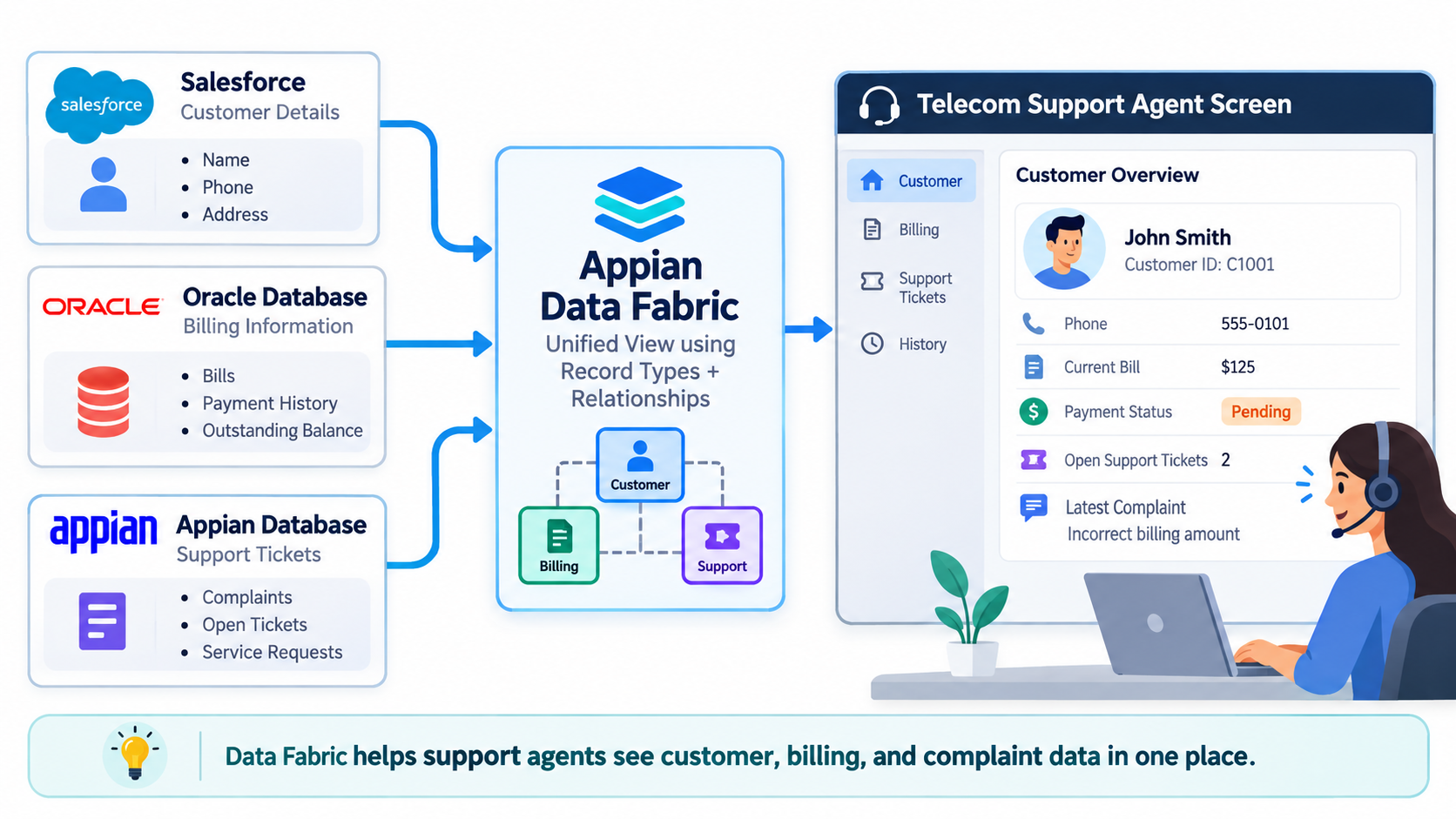
How Appian accesses the data
Appian supports two approaches:
- Synced record types: Appian keeps a synchronized copy of the source data in its own data service, which speeds up queries.
- Unsynced record types: Appian reads from the source system when it needs the data, without keeping a copy.
Developers still have to set up the connections and integrations that reach external systems.
Why it’s useful
- Users see related information from several systems in one application, so they don’t switch between tools to find it.
- Developers reuse record types and relationships instead of rewriting complex data retrieval logic for each screen.
- Synced record types can retrieve data faster.
- Dashboards and reports can draw on related business data across systems.
- Processes can use the connected data to automate operations.
Put briefly, Data Fabric uses record types and relationships to bring data from multiple systems together. That makes the data easier to reach and the applications easier to build.
Official reference: Appian, what is data fabric?
Check yourself
Question 1 of 5, on what the answer above covers.
1. A teammate says, "Data Fabric copies all our data from every system into one big Appian database." What's the accurate correction?
2. A telecom keeps customer details in Salesforce, bills in Oracle, and tickets in the Appian database. A support agent needs all three on one screen. How would you build it?
3. A project manager assumes Data Fabric means no integration work: "Just add the record types and the Salesforce data appears." What's missing from that picture?
4. Which of these is a real benefit of building on record types and relationships, as in the telecom example?
5. Support agents run the same customer and billing lookups all day, and the queries feel slow. Which change is most likely to help?