Question
Is your application record-based or CDT-based? What are the key differences between CDTs and Records, and why did you choose Records?
A
Anonymous
December 27, 2025
136
Answer
Earlier, we used CDTs for data handling, but we moved to Record Types because they provide better features, performance, and scalability.
Key Differences
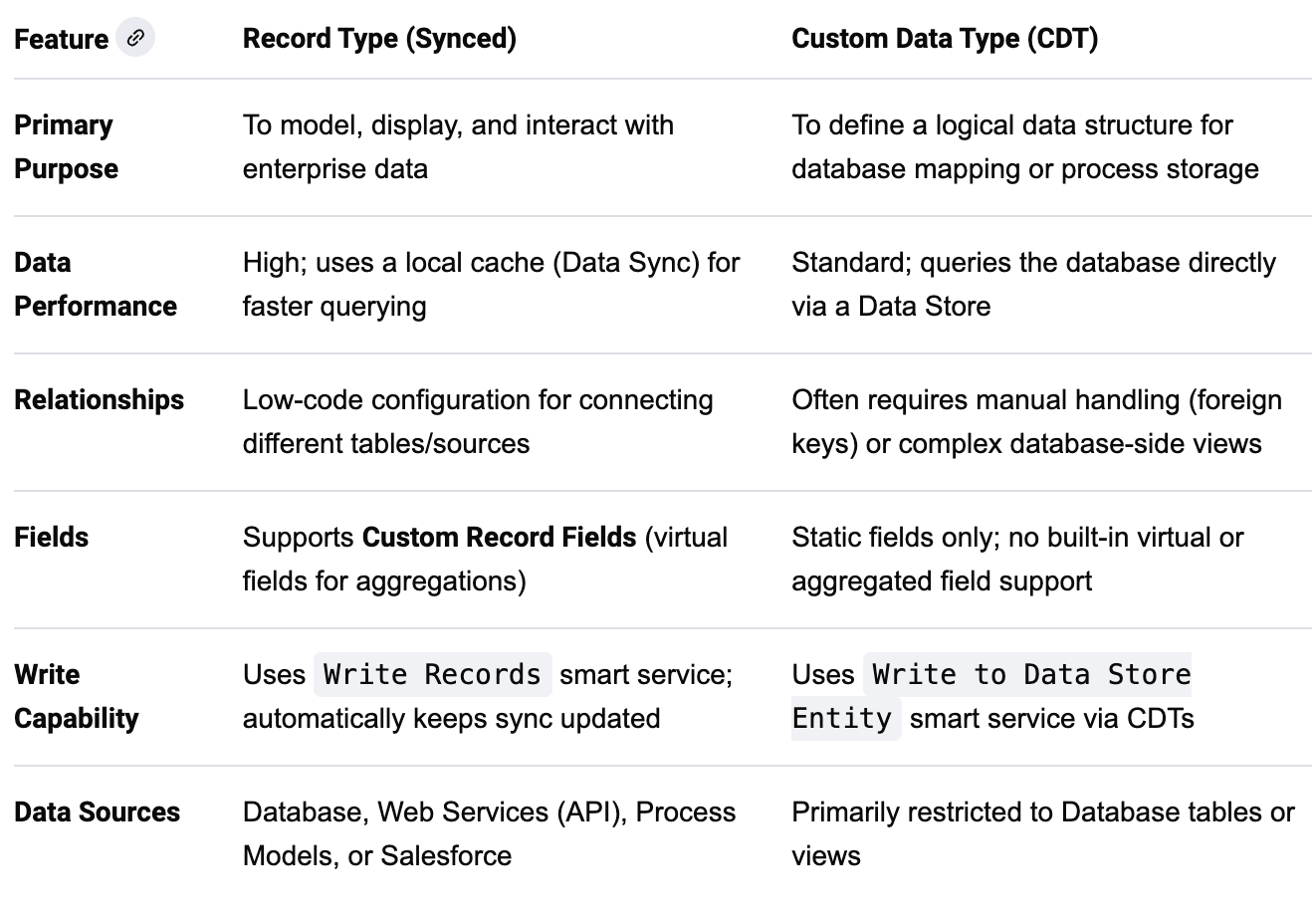
When to Use Each
Use Record Types When:
- Building a Modern UI: Records allow you to create lists, filters, and record views with minimal coding.
- Speed is Critical: Synced records provide faster query results because they pull data from memory rather than executing a full database call every time.
- Handling Complex Reporting: Use Custom Record Fields to aggregate data (e.g., total sales per customer) directly on the record.
- Working with Multiple Sources: If your data comes from both a database and an external API, records can unify them into a single data model.
Use CDTs When:
- Unsynced Data Needs: If you are using an Unsynced Record Type, you still need a CDT and a Data Store Entity (DSE) to map the database table.
- Legacy Requirements: Older process models or specific smart services (like "Export DSE to Excel") still require CDTs for their configuration.
- Process Variables: CDTs remain useful for storing temporary, strongly-typed data structures within a single process instance.
- External Integration: Some web service integrations or Java-based plugins require a CDT to define the incoming/outgoing data structure.
Appian now recommends using synced record types for most new development due to their increased flexibility, performance, and built-in functionality.
JuniorSeniorRecords
Loading comments...