What are the gateways in Appian with examples?
What are the gateways in Appian with examples?
Answer
Exclusive (XOR) Gateway
This is the most common gateway and acts as a decision point where only one outgoing path can be taken, even if multiple conditions are met. Conditions are evaluated sequentially (top to bottom), and the first one that evaluates to true is executed.

- Example: In an approval process, the flow goes to the "Approve" path if pv!approvalStatus is "Approved", or the "Reject" path if pv!approvalStatus is "Rejected". Only one can be selected for a given instance.

Inclusive (OR) Gateway
This gateway allows one or more outgoing paths to be followed simultaneously, based on the conditions set. Every path with a condition that evaluates to true is activated.
-

- Example: A travel request process. After initial approval, the system checks: is a hotel needed? is a flight needed? is a rental_car needed? The process can then proceed down the "Book Hotel" path, the "Book Flight" path, or both, or neither, depending on what the user requested.

Parallel (AND) Gateway
This gateway is used to create parallel, concurrent paths in a process. It automatically activates all outgoing branches simultaneously, without evaluating any conditions.

- Example: A new employee onboarding process. Once initiated, the process splits into parallel paths for "IT Provisioning" and "HR Onboarding Documentation". Both must be completed before the employee can start their first day. It is also used to join these paths later, waiting for all incoming flows to arrive before proceeding.

Complex Gateway
This is a sophisticated, highly customizable gateway used only when the standard gateways cannot handle the required logic. It allows for complex logic regarding which incoming paths are accepted and how outgoing paths are determined.

- Example: In an insurance claim process that requires approvals from multiple departments, you might configure a complex gateway to proceed only when you have received at least two out of three possible incoming approvals from "Claims", "Finance", and "Legal". It provides granular control over synchronization and routing

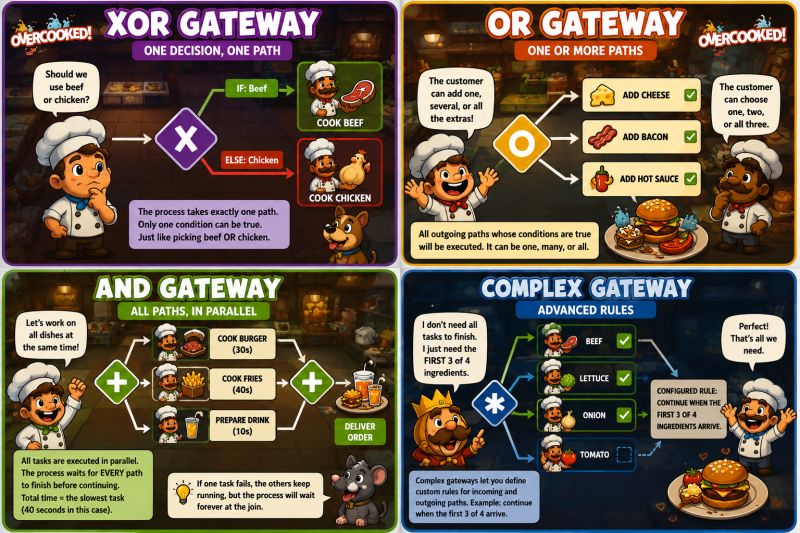
Gateways Explained with Overcooked Analogy
Think about a customer ordering a burger, fries, and a drink.
The fastest way to complete the order is not to prepare everything sequentially. Instead, each person takes a task and everyone works at the same time.
That's exactly how an AND Gateway works.
Now imagine the customer must choose between a beef burger or a chicken burger.
Only one option can be selected.
That's an XOR Gateway.
What about optional extras like cheese, bacon, or hot sauce?
The customer can choose one, several, or all of them.
That's an OR Gateway.
And finally, imagine a special kitchen rule where an order can move forward only when specific conditions are met.
That's where a Complex Gateway comes into play.
The reason I like this analogy is simple: When I think about Gateways, I no longer think about BPMN symbols. think about a chaotic Overcooked kitchen.
And surprisingly, that's much easier to remember during an exam.
(See the cards below for a visual explanation of each Gateway.)