What are the gateways in Appian explain with examples?
What are the gateways in Appian explain with examples?
Answer
Exclusive (XOR) gateway
An XOR gateway is a fork in the road where the process can take only one path. It checks its conditions from top to bottom and follows the first one that is true. Even if a later condition is also true, the gateway ignores it.
Example: a manager reviews a leave request and picks Approved or Rejected from a dropdown. That choice is saved in a process variable called pv!approvalStatus. The XOR gateway has two conditions:
- pv!approvalStatus = “Approved” leads to “Send approval email”
- pv!approvalStatus = “Rejected” leads to “Notify employee of rejection”
If the manager picked Approved, the first condition is true, so the process goes to the approval email and never looks at the second path. One request, one outcome.
Beginner tip: always add an Else (default) path. If someone saves a status you didn’t plan for, like “On Hold”, none of your conditions match and the process has nowhere to go. An Else path catches those cases, for example by sending the request back to the manager.
Inclusive (OR) gateway
An OR gateway checks every condition, and every path whose condition is true runs. That could be one path, several, or all of them.
Example: an employee submits a travel request with three checkboxes: Need hotel, Need flight, Need rental car. After the request is approved, the OR gateway checks each one:
- pv!needsHotel = true leads to “Book hotel”
- pv!needsFlight = true leads to “Book flight”
- pv!needsCar = true leads to “Book rental car”
Here’s how different requests play out:
- Priya ticks only Flight. Only “Book flight” runs.
- Sam ticks Hotel and Flight. “Book hotel” and “Book flight” both run at the same time.
- Alex ticks all three. All three paths run.
- Jordan is driving his own car to a meeting nearby and ticks nothing. No condition is true, so the process needs a default path such as “No bookings needed, close request.” Without it, the process gets stuck, same as the XOR case.
The difference from XOR: XOR stops at the first true condition, while OR runs every true one.
Parallel (AND) gateway
An AND gateway doesn’t check anything. It sends the process down every outgoing path at once.
Example: HR clicks “Start onboarding” for a new hire named Maria. The AND gateway splits the work into two paths that run side by side:
- IT path: create Maria’s email account, order her laptop, give her system access
- HR path: collect her tax forms, set up payroll, enroll her in benefits
The IT team doesn’t wait for HR to finish, and HR doesn’t wait for IT. Both teams start right away, which is faster than doing one after the other.
You can also use an AND gateway to bring the paths back together. Put a second AND gateway after both paths, before the “Ready for day one” step. It waits until both the IT path and the HR path have arrived. If IT finishes on Monday and HR finishes on Wednesday, the process waits until Wednesday and then moves on. Maria’s first day isn’t confirmed until everything is done.
Complex gateway
Use a Complex gateway only when XOR, OR, and AND can’t express the rule you need. It lets you control how many incoming paths must arrive before the process continues, and which outgoing paths it takes.
Example: an insurance claim needs approval from three departments: Claims, Finance, and Legal. The company rule is that two out of three approvals are enough. All three reviews happen in parallel, and the paths come back into a Complex gateway set to “continue when 2 incoming paths have arrived.”
- Claims approves on Monday. One of three. The gateway keeps waiting.
- Finance approves on Tuesday. Two of three. The gateway continues and the claim moves to payment.
- Legal approves on Thursday. The process has already moved on.
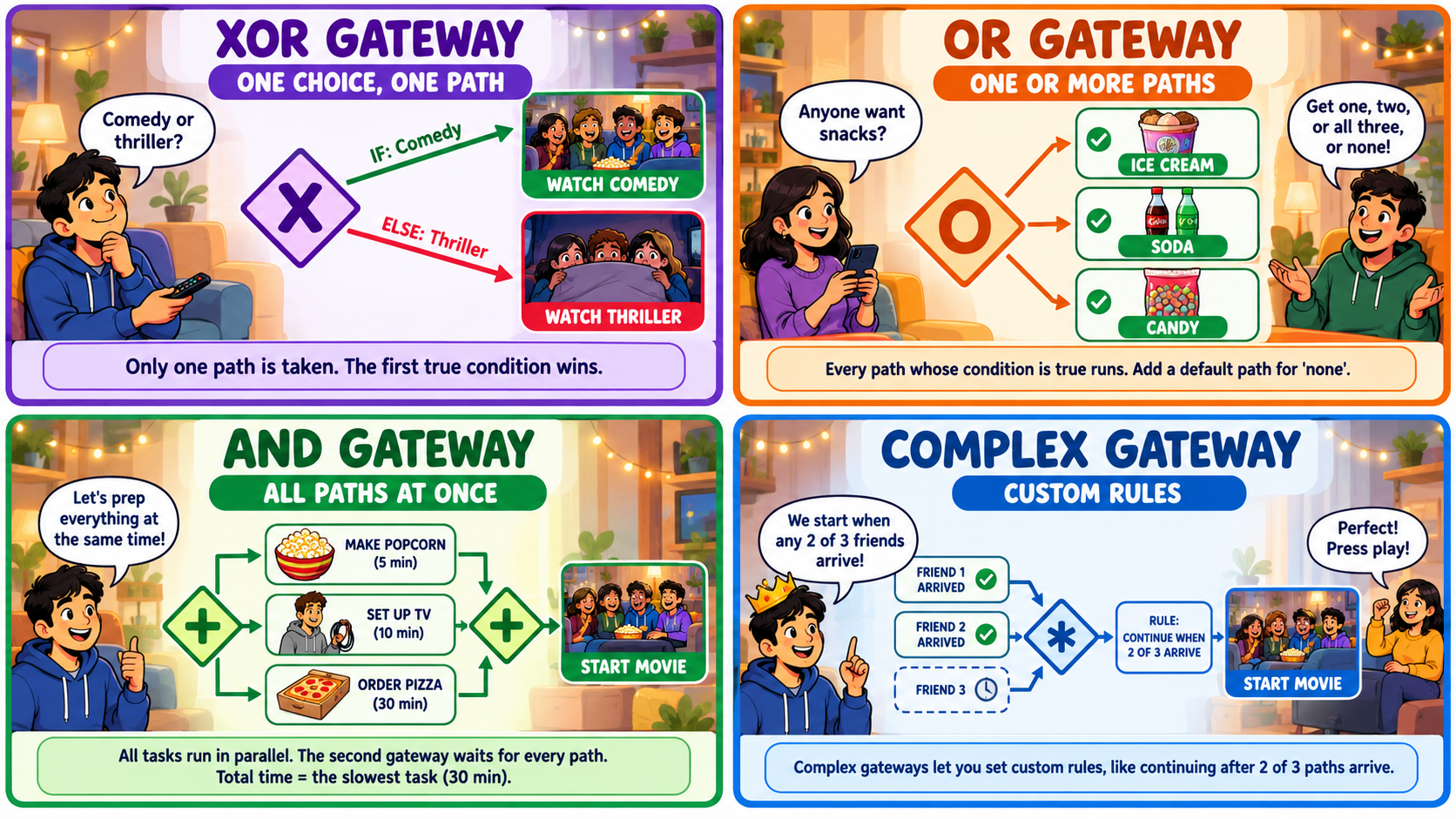
Gateways explained with a movie night
AND
You’re hosting a movie night and three friends are coming over.
Before anyone arrives, there’s prep to do. Your roommate sets up the TV while you make popcorn and order pizza on your phone. All three jobs happen at the same time. The movie doesn’t start until every one of them is done, because nobody wants to watch with a broken TV or no food. That’s an AND gateway: split the work, then wait for all of it to finish.
XOR
Next, the group picks a movie. Half the room wants a comedy and half wants a thriller, but you can only watch one, so one wins. That’s an XOR gateway.
OR
Then there are the extras. Should someone grab ice cream? Soda? Candy from the corner shop? You might get one, two, all three, or nothing if everyone’s full from pizza. Whatever people ask for gets bought. That’s an OR gateway, and “nobody wants anything” is the default path.
COMPLEX
Last, the start time. One of your friends is always late, and you don’t want to wait for him. So you set a rule: the movie starts once any two friends arrive, and the third joins halfway through. Counting arrivals like “2 out of 3” is something only a Complex gateway can do.
Check yourself
One quick question on what the answer above covers.
1. At movie night, half the room wants a comedy and half wants a thriller, but you can only watch one. Which gateway is this?